

Does Window Glass Thickness Matter? Why Thicker, Tempered Glass Makes a Difference
Oct 22, 2026
When replacing windows in your home, glass thickness is one of the most overlooked features and one of the most important to understand.
Most homeowners compare replacement windows based on appearance, price, energy efficiency, and warranty coverage. But there’s another important question that rarely gets asked:
How thick is the glass, and is it tempered?
The answer can affect how much outside noise enters your home, how well your windows withstand everyday stresses, their long-term performance, and how safely the glass breaks if an accident occurs.
For homeowners in Los Angeles, Orange County, Riverside County, and San Bernardino County, these considerations are particularly important because of traffic noise, earthquakes, hot weather, and wildfire concerns.
At Smart Window Company, we believe homeowners should understand exactly what they’re purchasing. That’s why The Smart Window comes standard with 3/16-inch tempered glass on the interior pane and 1/8-inch glass on the exterior pane of its dual-pane insulated glass unit.
Here’s why that combination matters.
1. Does Thicker Window Glass Reduce Outside Noise?
Yes. Thicker window glass can significantly improve sound resistance, particularly when paired with another pane of a different thickness.
If you live near a busy street, freeway, airport, school, or neighborhood with frequent outdoor activity, reducing noise may be one of your biggest priorities.
Sound travels through glass by causing it to vibrate. Generally, thicker glass has greater mass, making it more difficult for certain sound frequencies to pass through.
However, simply making both panes thicker isn’t necessarily the best solution.
One particularly effective approach is to use two different glass thicknesses in a dual-pane window.
Why?
Glass panes of identical thickness tend to respond similarly to certain sound frequencies. By using panes of different thicknesses, those resonances occur at different frequencies, helping reduce sound transmission.
The Smart Window features:
- Interior pane: 3/16-inch tempered glass
- Exterior pane: 1/8-inch glass
- Between the panes: An insulating space filled with argon gas
This asymmetrical glass configuration is an excellent choice for homeowners seeking improved everyday sound resistance without automatically upgrading to more expensive specialty soundproofing glass.
Actual noise reduction also depends on the window’s overall construction, airspace, weatherstripping, and installation quality.
2. Does Thicker Glass Help Prevent Window Seal Failure and Condensation?
Thicker glass is more resistant to bending and flexing, which can be beneficial to the long-term performance of a double-pane insulated window.
Glass naturally flexes in response to wind pressure, temperature changes, and differences in atmospheric pressure.
Thinner glass generally bends more easily than thicker glass of the same dimensions.
Over time, environmental stresses place demands on the seals around an insulated glass unit.
Those seals are especially important because modern energy-efficient double-pane windows frequently contain argon gas between their panes.
Argon improves insulation by reducing heat transfer through the glass assembly.
When the insulated-glass seal fails, argon can escape, outside air and moisture can enter, and condensation or fogging can eventually develop between the panes.
A thicker pane helps reduce glass deflection, but it is the complete insulated-glass design—including the spacer system, sealants, manufacturing quality, and proper installation—that determines how effectively the unit retains argon and resists moisture intrusion.
That’s why The Smart Window combines its thicker interior glass with:
- Dual-pane insulated glass
- Argon gas between the panes
- Low-E3 energy-efficient glass coating
- A stainless steel Intercept spacer system
Together, these features are designed to provide lasting thermal performance and help reduce the risk of premature insulated-glass failure.
3. Is Tempered Window Glass Safer in a Fire?
Tempered glass offers greater resistance to thermal stress than ordinary annealed glass, but it should not be confused with fire-rated glass.
Southern California homeowners are increasingly aware of wildfire risks and the importance of selecting quality building materials.
Tempered glass undergoes a special heat-treatment process that makes it approximately four times stronger than ordinary annealed glass of the same thickness.
This process also improves its ability to withstand certain temperature differences that can cause ordinary glass to crack.
However, it’s important to understand that standard tempered glass is not fireproof and does not provide the same protection as a tested, fire-rated window assembly.
Homes in designated wildfire hazard areas may require specific glazing and window assembly features under California building codes.
By including 3/16-inch tempered interior glass as standard, Smart Window Company provides an important strength and safety upgrade that homeowners can appreciate even when tempering isn’t specifically required by code.
For homes in wildfire-prone neighborhoods, the complete window assembly and applicable local requirements should also be evaluated.
4. Why Does Tempered Glass Matter During an Earthquake?
Tempered glass can reduce the risk of serious cutting injuries if a window breaks during an earthquake.
Earthquakes are an unavoidable consideration for Southern California homeowners.
During seismic activity, a home’s structure can shift, placing stress on window frames and glass.
Ordinary annealed glass can fracture into large, sharp pieces capable of causing serious injuries.
Tempered safety glass is different.
When tempered glass breaks, it is designed to crumble into relatively small fragments rather than the large, knife-like shards commonly produced by ordinary glass.
That can make a meaningful difference when people are near a window during an earthquake.
Tempered glass is not earthquake-proof, and it does not necessarily stay in the frame after breaking. Laminated safety glass may be preferable in applications where retaining broken glass is particularly important.
Nevertheless, using tempered glass on the interior pane of every Smart Window provides an additional measure of everyday safety for families.
5. Is 3/16-Inch Tempered Glass Better Than Standard 1/8-Inch Glass?
For many residential replacement-window applications, 3/16-inch tempered interior glass paired with 1/8-inch exterior glass offers an excellent balance of sound resistance, strength, safety, performance, and value.
Here’s how the two thicknesses compare:
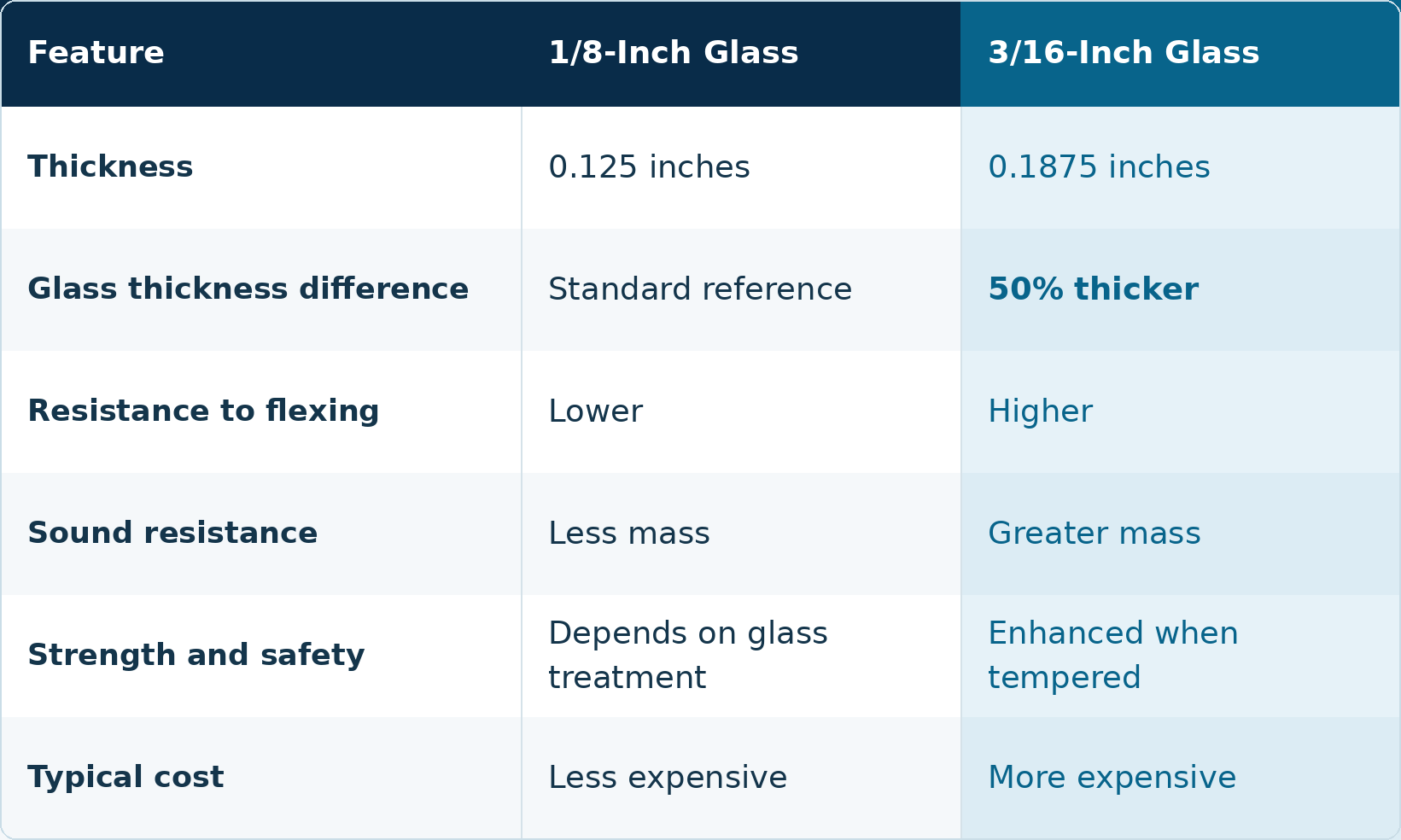
Of course, thickness and tempering are different characteristics. A thicker pane isn’t automatically tempered, and tempered glass isn’t necessarily thicker.
The benefit comes from selecting the right combination for the window’s intended application.
For homeowners who want a substantial improvement over older, thinner, non-tempered glass, the Smart Window’s standard configuration provides an appealing combination of features.
6. Does Glass Thickness Affect Window Energy Efficiency?
Yes, although glass thickness alone isn’t the most important factor.
A window’s overall energy efficiency depends on several components working together, including:
- Low-E glass coatings that reduce unwanted heat transfer
- Argon gas between the panes
- The size and design of the insulating airspace
- Spacer and edge-seal technology
- The frame’s insulating properties
- The quality of installation
The Smart Window combines its 3/16-inch tempered interior glass with Low-E3 coating, argon gas, and a 100% virgin uPVC vinyl frame.
Its standard rated configuration has a U-factor of 0.30 and a Solar Heat Gain Coefficient (SHGC) of 0.23, making it well suited to many Southern California replacement-window applications.
Homeowners should always compare the actual NFRC performance ratings of the windows they’re considering, rather than judging energy efficiency by glass thickness alone.
7. Why Doesn’t Every Window Company Include Thicker Tempered Glass?
The simple answer is cost.
Thicker glass uses more material, weighs more, and generally costs more to manufacture and transport. Tempering introduces an additional manufacturing process.
Some window manufacturers reserve thicker or tempered glass for specific applications or offer it as an optional upgrade.
At Smart Window Company, we made a different decision.
We include 3/16-inch tempered interior glass as a standard feature on The Smart Window because we believe strength, safety, and sound resistance shouldn’t automatically require paying for an upgrade.
When comparing window replacement estimates, ask each contractor to specify the actual thickness of both glass panes and identify which panes are tempered.
Two replacement windows may look almost identical but contain noticeably different glass packages.
And those differences can matter long after installation.
The Bottom Line: What Glass Thickness Is Best for Replacement Windows?
For many Southern California homes, dual-pane windows featuring 3/16-inch tempered interior glass and 1/8-inch exterior glass offer an excellent combination of sound resistance, durability, safety, and value.
But glass thickness is only one part of selecting a quality replacement window. Proper seals, energy-efficient coatings, durable frames, quality hardware, installation, and warranty protection are equally important.
At Smart Window Company, we combine these features with transparent pricing, a no-pressure sales process, professional installation, and a comprehensive warranty covering materials and labor.
We proudly serve homeowners throughout Los Angeles County, Orange County, and portions of Riverside and San Bernardino counties.
Thinking about replacing your windows or sliding glass doors? Contact us today!
You deserve to know exactly what you’re buying and why it matters.
Frequently Asked Questions About Window Glass Thickness
1. Does window glass thickness really matter?
Yes. Window glass thickness affects resistance to bending, sound transmission, glass weight, and overall structural performance. When combined with tempering, thicker glass can also offer additional strength and safety benefits.
2. Is 3/16-inch glass better than 1/8-inch glass for replacement windows?
For many applications, 3/16-inch glass provides benefits because it is 50% thicker and more resistant to flexing. When tempered and combined with a second pane of a different thickness, it can provide an excellent combination of strength, safety, and sound reduction.
3. What is the best glass thickness for reducing traffic noise?
A dual-pane window with two different glass thicknesses, such as 3/16-inch and 1/8-inch, can help reduce traffic noise. For particularly noisy locations, homeowners should also compare tested STC and OITC ratings and consider specialized acoustic glass.
4. Is tempered glass safer than regular window glass?
Yes. Tempered glass is approximately four times stronger than ordinary annealed glass of equal thickness and is designed to break into small fragments rather than large, sharp shards, reducing the risk of serious cuts.
5. Does thicker window glass prevent condensation between panes?
Thicker glass reduces deflection, but it cannot guarantee against condensation. Moisture between window panes generally indicates an insulated-glass seal problem. High-quality spacers, durable seals, and proper manufacturing are critical.
6. Can argon gas leak out of double-pane windows?
Yes. Argon can gradually diffuse through insulated-glass seals over time. Excessive gas loss can occur when a seal deteriorates or fails. Proper manufacturing and durable sealing systems help preserve the window’s insulating performance.
7. Is tempered glass better for homes in earthquake-prone California?
Tempered glass offers a safety advantage because it breaks into relatively small fragments rather than large, sharp pieces. However, it cannot prevent all earthquake-related breakage, and laminated glass may be preferable where glass retention is important.
8. Does tempered glass protect a house from wildfires?
Tempered glass has better resistance to certain thermal stresses than ordinary glass, but standard tempered glass is not fire-rated or fireproof. Homes in wildfire hazard areas should use glazing and window assemblies that meet the applicable California building requirements.
9. Are all double-pane replacement windows made with the same thickness glass?
No. Manufacturers offer different glass thicknesses and combinations. Some use equal-thickness panes, while others use different thicknesses or offer tempered and laminated glass upgrades. Always ask for the exact specifications.
10. Does thicker glass make windows more energy efficient?
Thicker glass can affect overall window performance, but Low-E coatings, argon gas, glazing space, spacers, frames, and installation typically have a larger influence on energy efficiency. Compare NFRC U-factor and SHGC ratings.
11. Are Smart Window Company’s windows made with tempered glass?
Yes. The Smart Window includes 3/16-inch tempered interior glass as standard, paired with 1/8-inch exterior glass in its dual-pane configuration. Additional safety glazing requirements may apply to particular window or door locations.
12. Where can I buy replacement windows with thicker tempered glass in Southern California?
Smart Window Company offers replacement windows featuring 3/16-inch tempered interior glass as standard. The company serves Los Angeles County, Orange County, and selected communities in Riverside and San Bernardino counties, providing transparent quotes and professional installation.


